
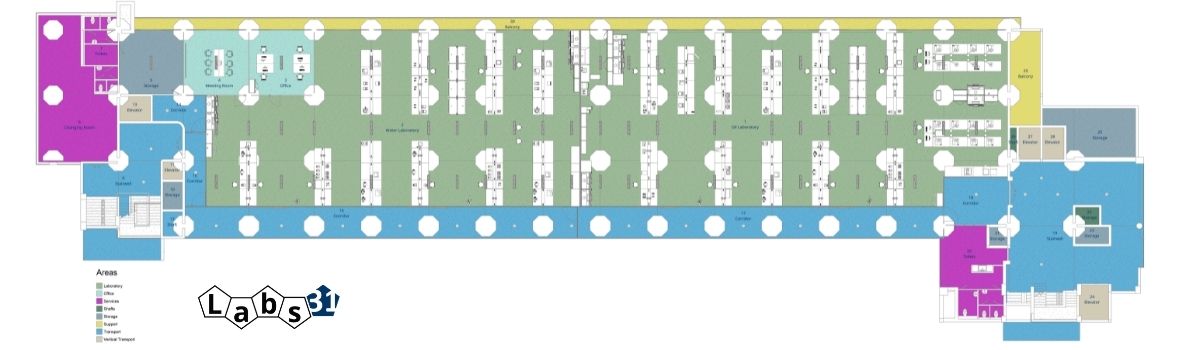
A laboratory floor plan is a way to provide insight into a laboratory's use. They are often used during the sketch phase of designing a lab. It is an overview of the preliminary layout of the laboratory.
The laboratory floor plan shows the following:
- The location in the lab where various studies are performed
- The connections needed for these specific investigations
- Which spaces belong to be able to perform these
- What equipment is needed
The laboratory floor plan also indicates which safety requirements and standards apply per different rooms and departments within the laboratory.
When do you use a laboratory floor plan?
As indicated earlier, you use a laboratory floor plan in the sketch phase of designing your laboratory. To be precise in the optimization of the laboratory design.
During this phase of the design, the relationship between the different groups of subjects is analysed. The rough plan is drawn up on the basis of the various spaces. It will balance several parameters.
How do you design a laboratory floor plan?
One way to design a laboratory floor plan is through the BIM software Revit. It is software that integrates all architectural, engineering and construction disciplines into a single modelling environment. This results in more efficient and cost-effective projects.
What are the advantages of a laboratory floor plan?
A floor plan is necessary when dividing up a new space. But it is also an opportunity for companies that want to better identify their opportunities. A floor plan can be used for many different things. It can be used to determine a new walking route in your laboratory or for a new layout. The floor plan takes into account the other factors within the lab, together with the size of the space and any future visions.
Safety within a laboratory and the floor plan:
When designing a laboratory, safety within the laboratory is taken into account. This can be illustrated in the floor plan. It shows where access is possible via multiple routes, where the research phases are separated to limit cross-contamination and the locations of related processes. In this way, you optimise the layout and accessibility of your laboratory.
How can we help you?
Let us meet and talk about your challenges, looking for the best possible solution for you and your company!
We can help you with consultancy, project management and turnkey laboratory projects.